2026/11/16
Can Rattan Get Wet? What Actually Happens to Natural and Synthetic Woven Furniture
A waiter sets down a sweating glass on a rattan dining chair. Ten minutes later there is a pale ring in the weave. Somewhere else, a homeowner forgets a woven armchair on an exposed terrace overnight and wakes up to swollen joints and a chalky finish. Both incidents look identical to the eye and have completely different causes.
The short answer is that rattan can get wet, but "rattan" is doing too much work in that sentence. Natural rattan comes from the stems of climbing palms and it absorbs water like any other fibrous plant material. Synthetic rattan is an extruded plastic strip and it does not. One of those two answers belongs in a specification sheet; the other one belongs in a warning label.
Up front conclusion
Natural rattan tolerates brief surface wetting and light cleaning, provided it is blotted and dried in moving air within a few hours. It does not tolerate soaking, rain, high-humidity storage, or standing water. PE and PVC synthetic rattan is genuinely water-resistant and can stay outdoors indefinitely, subject to ultraviolet exposure rather than moisture.
That distinction matters commercially because natural and synthetic weave are frequently sold side by side in the same showroom, with the same silhouette and almost the same texture. Buyers who assume the two behave alike end up with claims, returns, or a restaurant floor full of chairs that smell faintly of damp straw.
Content
The difference is not a matter of finishes or price tiers. It starts at the cell level, and everything that follows, including swelling, mould, finish cracking, and repairability, flows from that.
Natural rattan is the peeled stem of a climbing palm. It consists of dense vascular bundles embedded in softer parenchyma tissue, and those bundles run lengthwise to conduct water through the living plant. Even after drying and finishing, that architecture remains porous. The fibre saturation point of cane sits in a similar band to hardwood, and at normal indoor relative humidity the material settles at a balanced moisture content somewhere in the low teens. Below that equilibrium, the cell walls take on water and expand; the fibres move laterally as well as longitudinally, which is precisely the movement a weave cannot accommodate.
Damage is rarely instantaneous. It follows a predictable sequence, and knowing the sequence makes it easier to spot early-stage problems during goods inspection.
Synthetic rattan is normally high-density polyethylene or PVC, extruded into a strip and embossed to imitate cane texture. The material is closed-cell, so water stays on the surface rather than entering the wall. Its failure modes are thermal and photochemical: ultraviolet embrittlement, colour fade, and expansion under direct sun. Surface water is not one of them.
Natural cane
Absorbs moisture, swells laterally, requires a coating, vulnerable to mould, repairable by re-coating.
PE / PVC weave
Closed-cell, unchanged by surface water, dependent on UV stabilisers, repairable only by re-stranding.
Topcoat
The first line of defence for cane, and the first thing to fail. Film integrity defines service life.
The comparison below reflects typical commercial ranges rather than a single laboratory test. Use it to frame specification questions, not as a substitute for a supplier's own test report.
The pattern is consistent across product categories: natural cane asks for controlled humidity and periodic re-finishing, while synthetic weave asks for UV-stable compound and careful colour matching between batches. Neither is maintenance-free, but the maintenance is of an entirely different kind.
The chart below estimates the equilibrium moisture content cane will settle at in different environments. The scale matters because 20 percent is roughly where mould becomes a realistic risk rather than a theoretical one.
Two takeaways. First, humidity alone will push cane toward the mould threshold over enough time, even without a spill. Second, the jump between a covered porch and direct rain is not linear; it is the difference between a material that recovers and a material that has to be replaced.
End-use distribution explains why so much woven seating is sold into environments where it will inevitably be splashed. The segments below are approximate and intended to show proportion rather than a precise market survey.
Outdoor terraces and gardens, about 40 percent
Indoor residential seating, about 35 percent
Hospitality and commercial dining, about 20 percent
Storage and decorative pieces, about 5 percent
The interesting overlap is hospitality. Restaurant and cafe seating is indoor in principle but sees frequent spillage, damp mopping, and near-constant occupancy. A natural cane chair specified purely on appearance for a busy dining room will usually show finish wear at the seat front within a single season.
The decision is straightforward once the exposure scenario is fixed. A short sequence keeps the specification defensible.
Step 1 — Fix the exposure
Open sky means synthetic weave. Roofed but unheated means natural with a cover and drainage-aware placement. Fully indoor and climate-controlled means either.
Step 2 — Inspect the weave
Check wrap tension, cut-end sealing, and whether the frame moisture content is stated and stable. Unsealed cut ends are the entry point in almost every natural cane failure.
Step 3 — Confirm the finish system
Ask for film type, number of coats, and the recommended re-coating interval. If none is documented, assume a twelve to twenty-four month cycle.
Step 4 — Plan the response
Write a short spill procedure into the care manual: blot, lift the item, ventilate, and never stack wet pieces against each other.
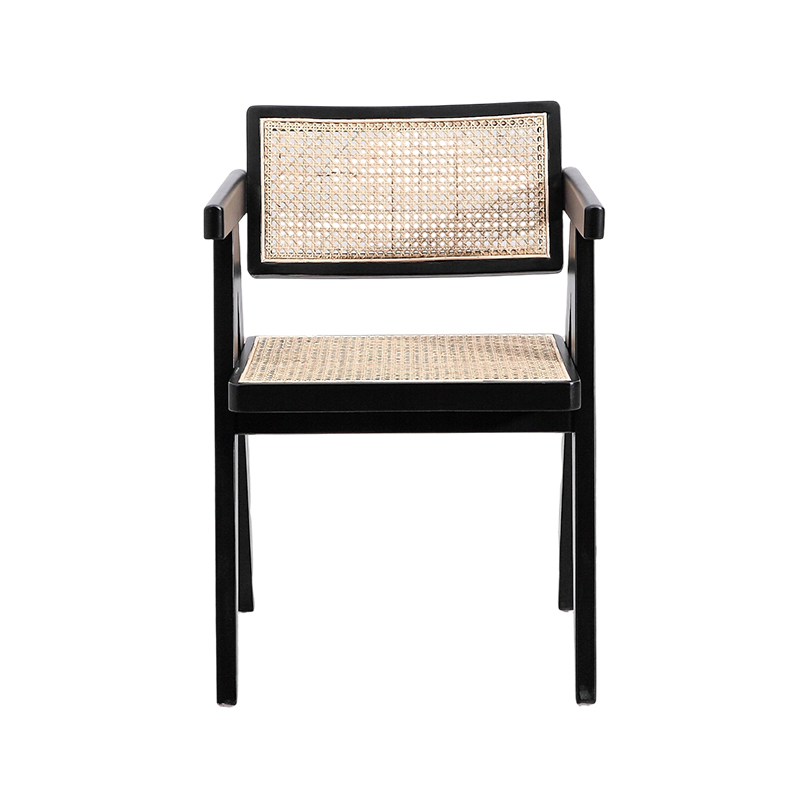
For indoor dining rooms, a black frame with woven cane is a useful reference point because frame finish and weave are contrasted deliberately, and the cane section can be inspected easily during acceptance checks. The procurement and design guide to rattan furniture covers the same trade-offs in more depth.
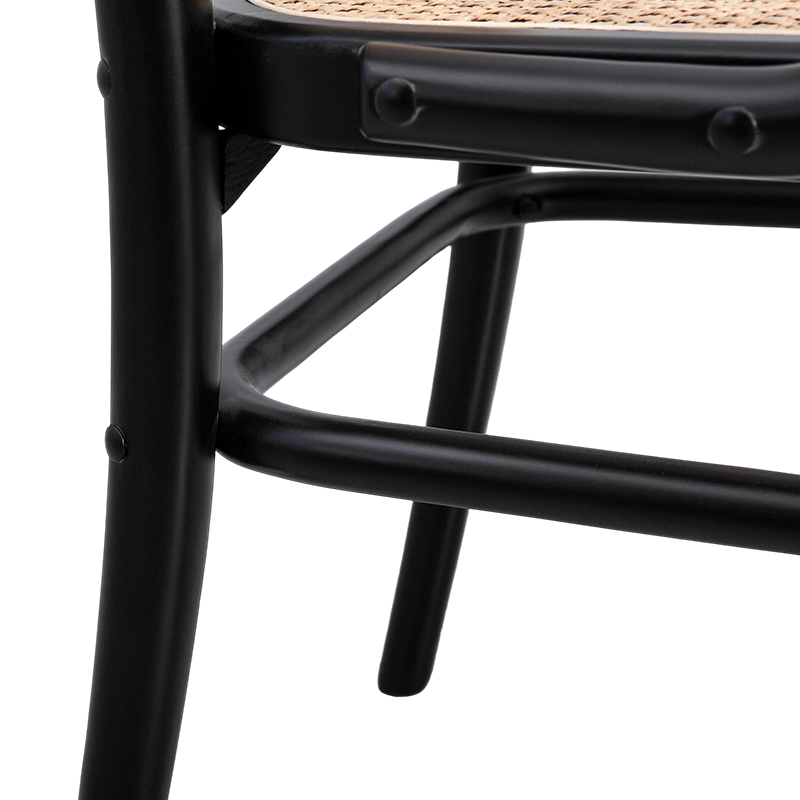 Black Frame Woven Rattan Wood Dining ChairBlack metal frame contrasts with handwoven rattan and solid wood armrests and legs, making weave inspection easier for indoor dining and commercial settings.View Product →
Where the cane is used as a seat mat rather than a structural weave, the moisture path is different again, since the mat sits on a solid frame and drains less freely. A cross-back chair with a rattan mat is a good example of this configuration and a sensible choice for restaurants that want woven appearance without exposed strand ends.
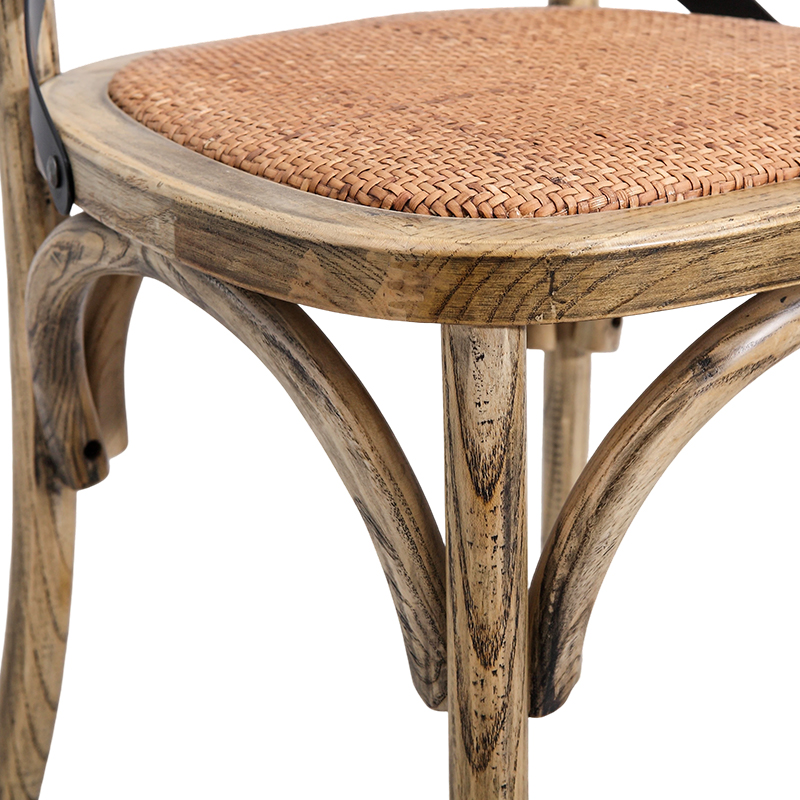 Cross Back Oak Dining Chair with Rattan MatSolid oak frame with woven rattan seat and metal cross-back detail suits dining rooms; stackable option helps storage where woven appearance is wanted.View Product →
Buyers comparing weaving techniques and how they age under use will find useful detail in this guide to handmade woven chair construction.
The handling rules are simple and mostly about speed. The longer water stays in contact with natural cane, the less of the outcome can be recovered.
For contract and hospitality projects, moisture-relevant documentation usually means a frame moisture content declaration, a finish specification with re-coating intervals, and a care manual that includes an explicit spill procedure. On the compliance side, buyers typically ask for formaldehyde emission limits on any engineered wood components, volatile organic compound declarations for the coating system, and stability and strength testing for the finished chair. Outdoor synthetic weave may additionally be requested with UV ageing test data, since that, rather than water, is the dominant degradation route.
The practical rule is simple. Water is a manageable event for natural rattan and a non-event for synthetic rattan. What is not manageable is specifying the wrong one and discovering the difference after the first wet season.




Innovation Oriented, Quality As Life.
Feel free to reach our if you want to collaborate with us, or simply have a chat.
Become a Client 
Product Category
Wood Upholstered Chair
Woven Wood Chair
Wood Bar Stools
Wood Table
FSC Certified Wood Chairs
Wooden Rattan Chairs
Solid Wood Dining Chair
Modern Wooden Dining Chair
Contact Information
 +86-571-63521858
+86-571-63525898
 furniture@hzchangshun.com
emilypeng@hzchangshun.com
 No. 88, Zhumufan, Yushan Township, Fuyang District, Hangzhou City, Zhejiang Province, China


 EN

 English
 中文简体
 Español