2026/04/21
Content
A wooden table occupies a different category from most furniture purchases. Unlike upholstered seating or metal shelving, a well-constructed wooden table is designed to outlast trends, owners, and even the homes they are placed in. The structural logic behind this longevity starts with the material itself. Solid wood — particularly dense hardwoods like white oak, walnut, ash, and beech — has a cellular structure that gives it an exceptional strength-to-weight ratio. When jointed correctly and finished with appropriate surface protection, these tables resist the cumulative stress of daily use in ways that veneered particleboard or MDF-core alternatives simply cannot match over a ten-to-twenty-year horizon.
Beyond structural performance, wooden tables carry a quality that is difficult to articulate in specification sheets but immediately apparent in person: the warmth and visual depth that comes from natural grain, growth rings, and the subtle variation in tone across a single tabletop. No two pieces of solid wood are identical, which means no two solid wood dining tables are identical. This individuality is increasingly valued in residential interiors where mass-produced uniformity has become the default — a table with genuine character becomes a reference point for the room around it, rather than a background object.
Choosing a wooden table by appearance alone — without considering the species and its relevant properties — is a common oversight that leads to preventable dissatisfaction. Different wood species behave differently under load, humidity change, heat, and surface abrasion, and the right choice depends heavily on the environment the table will occupy and the intensity of use it will face.
The Janka hardness scale provides a practical starting point for surface durability assessment. A higher rating means greater resistance to denting and scratching from everyday contact — dropped cutlery, dragged plates, children's toys. The table below summarizes the most commonly used species in solid wood dining tables and their relevant characteristics:
| Species | Janka Hardness (lbf) | Grain Character | Best Suited For |
|---|---|---|---|
| White Oak | 1,360 | Open, ray fleck pattern | High-traffic family dining |
| Black Walnut | 1,010 | Fine, rich dark tone | Premium residential dining |
| Beech | 1,300 | Tight, uniform, pale | Nordic / minimalist styles |
| Ash | 1,320 | Pronounced, athletic grain | Industrial and modern styles |
| Rubberwood | 960 | Subtle, light-toned | Budget-conscious eco buyers |
Moisture content at the time of manufacture is equally important. Solid wood dining tables built from timber kiln-dried to 6–8% moisture content are substantially less prone to warping, splitting, or developing gaps between boards in centrally heated homes — where indoor relative humidity regularly drops below 40% during winter months. When evaluating suppliers or products, asking for the target moisture content specification is a simple checkpoint that distinguishes manufacturers with rigorous process control from those working with green or insufficiently dried timber.
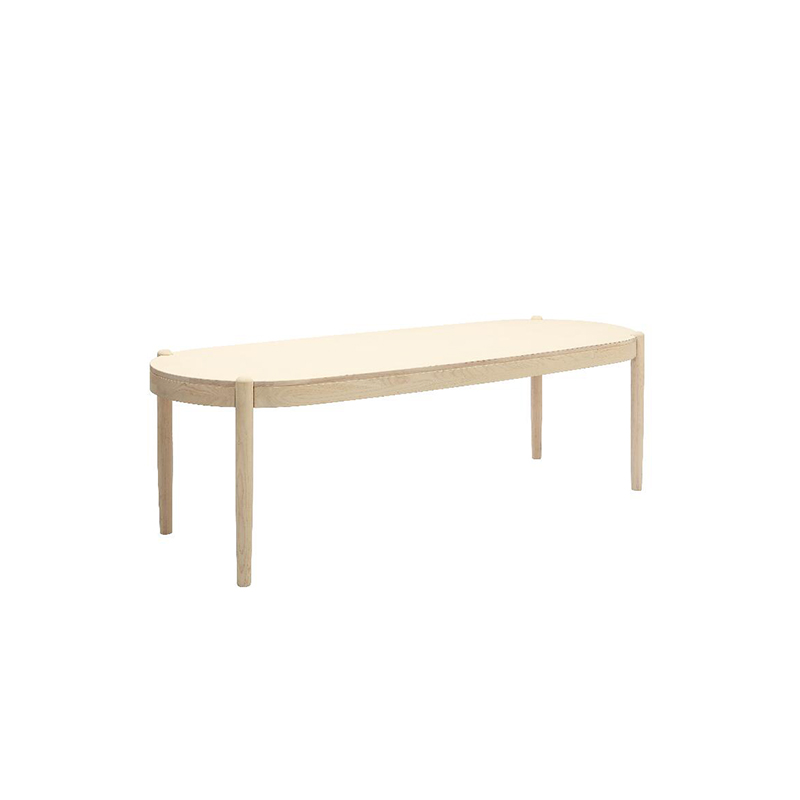
The relationship between aesthetic style and construction method in wooden tables is closer than most buyers appreciate. A table's visual language is not applied after the fact — it is built into the proportioning, joinery choices, and material pairings from the earliest design stage. Understanding this connection helps in evaluating whether a table is genuinely designed in a given style or simply finished to resemble one.
Nordic-influenced wooden tables are defined by restraint: slender tapered legs, minimal surface ornamentation, and a finish that allows the wood's natural texture to remain the primary visual element. Beech and ash are the most commonly used species in this tradition, chosen for their tight, even grain that reads as calm and undemonstrative. The joinery in authentic minimalist designs is typically concealed — no exposed hardware, no decorative pegs — because the visual logic of the style depends on surfaces appearing to join seamlessly. A lacquer or hardwax oil finish in a matte or satin sheen preserves the tactile honesty of the material without adding a reflective film layer that would feel at odds with the understated aesthetic.
Industrial wooden tables distinguish themselves through material contrast. The combination of solid wood tabletops — often in a dark, wire-brushed, or lightly distressed finish — with blackened or raw steel bases creates a visual tension that reads as urban and unconventional. Ash and reclaimed oak are frequently chosen for industrial applications because their pronounced grain absorbs the wire-brushing process well, accentuating the texture that gives these tables their characteristic ruggedness. The ironwork base in a well-designed industrial table is not a cost-saving substitution for solid wood legs; it is a considered material choice that introduces weight, rigidity, and a visual counterpoint to the warmth of the wood above.
Classical Chinese-style wooden tables represent one of the most technically demanding furniture traditions in existence. The defining characteristic is the near-total absence of metal fasteners — traditional Chinese joinery relies on complex interlocking mortise-and-tenon systems, some featuring over forty individual components in a single joint, that hold the structure together through mechanical precision rather than adhesive or hardware. The visual result — solemn symmetry, disciplined proportioning, restrained ornamental carving at aprons and spandrels — projects a calm authority that few other furniture traditions can match. Rosewood, elm, and Chinese ash are the species most associated with this tradition, chosen for their density, workability, and the deep luster they develop with age and polishing.
A point of confusion for many buyers is the distinction between a "live edge" or "single slab" top and an edge-glued panel — both of which can legitimately be described as solid wood dining tables. Understanding the difference helps set accurate expectations around appearance, pricing, and behavior over time.
A single-slab tabletop is cut from one continuous piece of timber and retains its natural outer edge — the live edge — giving each table a uniquely organic silhouette. These slabs require sourcing from old-growth or large-diameter trees, which drives material cost significantly higher and introduces greater variability in color and grain. An edge-glued panel assembles multiple narrower boards, jointed along their long edges with woodworking adhesive, to create a flat, stable top of the required width. When the jointing is well-executed and the boards are selected for consistent grain direction and color, the glue lines become nearly invisible and the panel performs as a single structural unit.
For most residential and commercial dining applications, a well-constructed edge-glued panel in a quality hardwood is the more practical choice. It is dimensionally more stable than a single wide slab — because narrow boards have less internal stress and are dried more evenly — and it is far more consistent in color and grain pattern, which simplifies furniture coordination across a room. Single-slab tops are best reserved for spaces where the organic form of the table is itself the design statement.
The finish applied to a wooden table determines its day-to-day maintenance requirements more than any other single factor. Three finish categories dominate quality solid wood dining tables, each with distinct trade-offs:
When evaluating finish quality in person, a simple test is to place a small drop of water on an inconspicuous area of the surface. A properly finished solid wood dining table will bead the water for at least several minutes. If the water absorbs immediately, the finish is either absent, exhausted, or of insufficient quality for the intended use context.
Correctly sizing a wooden table for a given room and household is one of the most practically consequential decisions in the purchase process, and one where buyers most commonly err — typically by choosing a table that is either too small to seat the intended number comfortably, or too large to allow adequate circulation around it.
The standard per-person width allocation for comfortable dining is 60–70 cm of tabletop edge length. At 60 cm, elbows are close but not touching; at 70 cm, there is ample space for place settings, glasses, and serving dishes without crowding. Using this benchmark, a table intended to seat six comfortably should have a minimum long-edge length of 180 cm, and ideally 200 cm. For round solid wood dining tables, a diameter of 120 cm accommodates four place settings; 150 cm is required for six.
Equally important is the clearance around the table itself. A minimum of 90 cm between the table edge and any wall or adjacent furniture is required to allow a seated person to push their chair back and stand without obstruction. In rooms where traffic passes behind seated diners — a common scenario in open-plan kitchens — 110–120 cm of clearance is a more comfortable target. Measuring these distances before selecting a table size prevents the frustrating situation of a beautiful table that renders a room functionally awkward to navigate.




Innovation Oriented, Quality As Life.
Feel free to reach our if you want to collaborate with us, or simply have a chat.
Become a Client 
Product Category
Wood Upholstered Chair
Woven Wood Chair
Wood Bar Stools
Wood Table
FSC Certified Wood Chairs
Wooden Rattan Chairs
Solid Wood Dining Chair
Modern Wooden Dining Chair
Contact Information
 +86-571-63521858
+86-571-63525898
 furniture@hzchangshun.com
emilypeng@hzchangshun.com
 No. 88, Zhumufan, Yushan Township, Fuyang District, Hangzhou City, Zhejiang Province, China


 EN
EN

 English
 中文简体
中文简体 Español