2026/06/04
A kitchen island changes how a home functions. It becomes the spot where guests naturally congregate, where breakfast happens before the day begins, where conversations extend long after dinner is finished. The furniture that serves this space needs to match the way it's actually used — and a bar stool that works well in a hotel lobby or a restaurant bar is not automatically the right choice for a kitchen island at home.
This guide examines the design and material decisions that separate a well-considered wood bar stool collection for kitchen and bar settings from one that looks fine in product photography but disappoints in daily use. The focus is on the decisions that matter most: height fit, ergonomic support, material quality, and the craftsmanship details that determine how a stool ages over years of use.
Content
Kitchen island seating is used differently from any other type of bar or counter seating. In a restaurant bar, guests typically arrive, sit for a defined period, and leave. In a domestic kitchen, the same stools serve a morning coffee drinker who stays five minutes, a teenager doing homework for two hours, and a group of friends eating a casual dinner that runs late. The stool needs to perform across all of these scenarios without failing at any of them.
The first dimension of that performance is height. Kitchen islands in residential settings typically sit between 880mm and 950mm from the floor — the counter-height range — which calls for a stool with a seat height between 580mm and 650mm. This maintains the 250–300mm clearance between the seat surface and the underside of the counter that allows comfortable thigh positioning. Islands finished higher than 960mm fall into bar-height territory and require stools in the 660–760mm range. Getting this wrong by even 50mm makes the seating uncomfortable enough that the stools get avoided.
The second dimension is the pattern of use. Kitchen island stools are climbed on and off repeatedly throughout the day — far more frequently than dining chairs or lounge seating. This repeated mounting and dismounting creates specific wear at the front seat edge and at the footrest rung, and places repetitive stress on the leg-to-rail joints that dining chair construction does not need to accommodate at the same intensity. A stool built with dining chair joint geometry and leg section sizes will show structural fatigue at these points within a few years of daily kitchen use.
The third dimension is visibility. Unlike furniture tucked against a wall, kitchen island stools occupy the center of a room and are viewed from multiple angles throughout the day. They are background and foreground simultaneously. This is why the choice of material — the texture of a woven seat, the warmth of a natural wood frame, the softness of a leather back — carries more visual weight in this position than almost anywhere else in the home.
The question of whether a bar stool needs a backrest is often treated as a style preference. It is also, and more fundamentally, a posture question — and the answer depends directly on how long the stool will be occupied at a stretch.
Without a backrest, the body maintains an upright seated posture through muscular effort alone. For short durations — five to fifteen minutes — this is not a problem for most adults. Beyond that, the lower back and core muscles begin to fatigue, and the posture compensates by rounding forward or shifting the pelvis. Neither adaptation is comfortable, and both signal that the furniture is working against the user rather than supporting them.
A well-designed backrest changes this equation entirely. The key is not the presence of a backrest but its geometry. A flat vertical back panel provides surface contact but does not support the natural lumbar curve — it simply gives the spine something to lean against while maintaining a posture that remains fatiguing over time. What distinguishes ergonomic wood bar stool design is a backrest that positions its contact point at the lumbar region (roughly 150–200mm above the seat surface) with a slight rearward angle of 100–105 degrees from the seat plane. This geometry allows the lower back muscles to release tension and the spine to maintain its natural S-curve without active muscular effort.
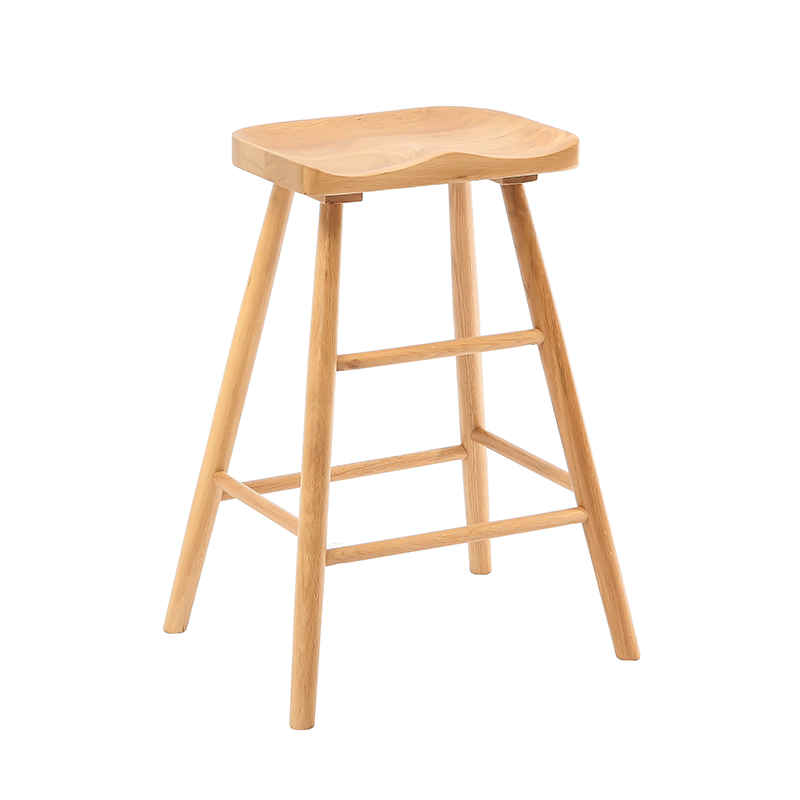
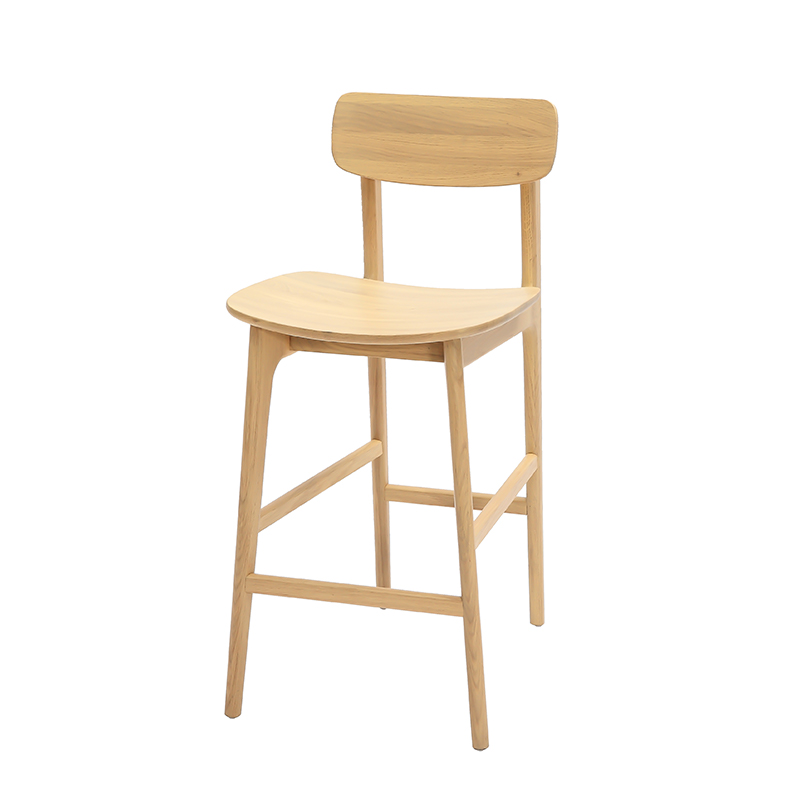
The arc seat dip wood bar stool with backrest applies this principle through a gently contoured seat surface — a shallow dip that positions the sit bones correctly — combined with a backrest shaped to make contact at the lumbar zone. The seat contour is not decorative; it is the mechanism that stabilizes the pelvis in a neutral position, from which good posture follows naturally rather than requiring effort to maintain.
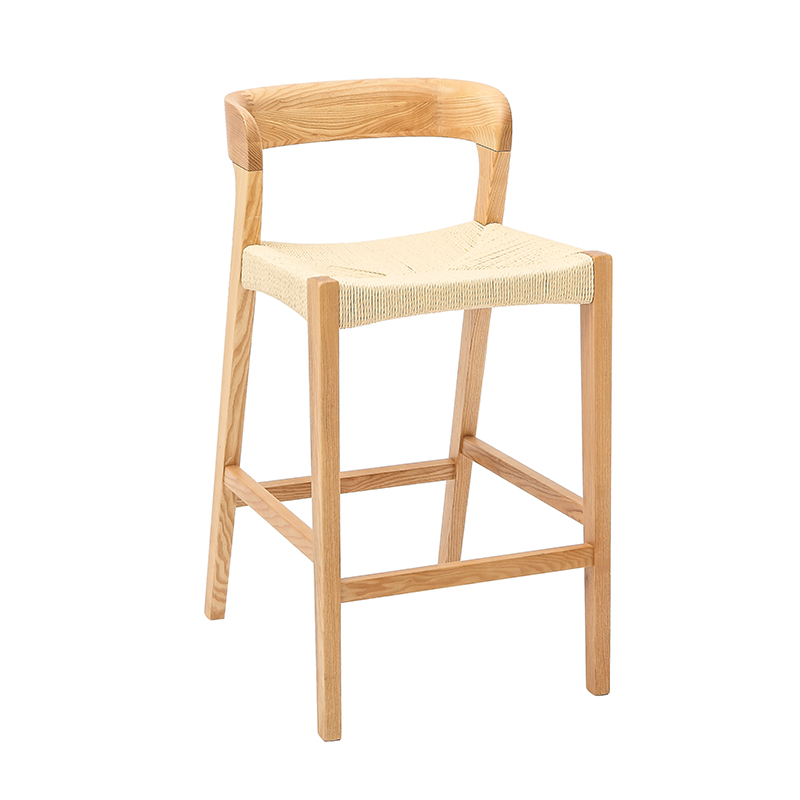
The rope woven bar stool with lumbar support addresses the same ergonomic objective through a different design language — the lumbar contact is built into the woven back panel, providing gentle support with the added sensory quality of a yielding, textured surface rather than a rigid wooden plane.
| Backrest Type | Lumbar Support | Best For | Aesthetic Character |
|---|---|---|---|
| Open / No back | None | Short-duration use, compact spaces | Minimal, airy, maximally versatile |
| Curved wood backrest | Moderate — depends on curve geometry | Casual dining, medium-duration seating | Sculptural, warm, showcases wood grain |
| Rope woven back with lumbar zone | Good — distributes contact across back surface | Extended sitting, textural interiors | Artisanal, tactile, coastal or natural aesthetic |
| Leather curved backrest | Good — conforms to body on contact | Premium residential, hospitality settings | Refined, modern, material contrast with wood |
The choice between a rope-woven surface and a leather seating surface is partly aesthetic and partly functional — and the two materials deliver genuinely different experiences in use, not just in appearance.
Rope weaving on a bar stool seat or backrest is a craft tradition with deep roots in Scandinavian and coastal furniture making. The technique involves tensioning natural or synthetic cord around a solid wood frame in a defined pattern, producing a surface that is simultaneously structural and decorative. A well-executed rope seat has meaningful flex — it yields slightly under body weight, distributing pressure across a broader surface area than a rigid wood seat and reducing the localised pressure points that cause discomfort on longer sits. The open weave also allows air circulation beneath the user, which matters particularly in kitchen environments where ambient temperatures rise during cooking.
The craft dimension of rope weaving is also visible and tangible in a way that most furniture materials are not. The pattern of the weave, the tension of the cord, the way it wraps and ties at the frame edges — these are details that reward close attention and communicate the involvement of skilled hands in the making of the piece. This quality is increasingly valued in residential interiors where the uniformity of mass-produced furniture has created appetite for pieces that show evidence of individual making.
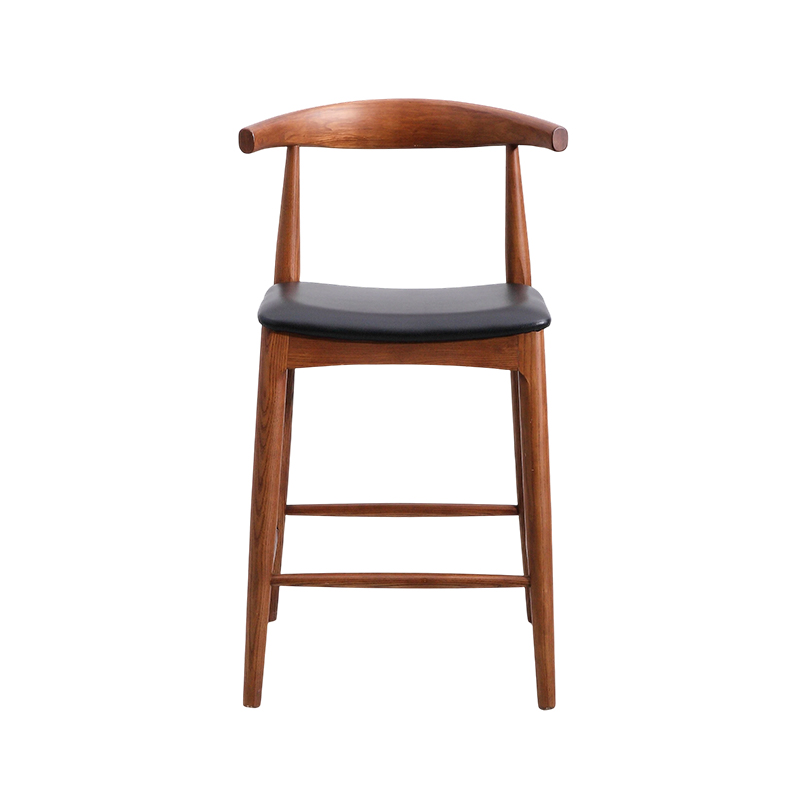
Leather seating on a bar stool delivers a different set of qualities. The leather seat bar stool with curved backrest pairs a natural wood frame with a leather back panel whose curve follows the geometry of the lumbar spine. Leather as a seating material has several practical advantages in this application: it is easy to wipe clean, which matters in a kitchen environment where spills are inevitable; it softens and develops a patina with use, improving in character over time rather than degrading; and it creates a visual tension with the wood frame — the softness of the leather against the structural hardness of the wood — that reads as considered material contrast rather than coincidence.
The key to both materials working successfully in the same product series is the consistency of the wood base. When rope weaving and leather seating are applied to frames of identical proportion, joinery, and finish, the collection reads as coherent even as individual pieces vary in surface character. This is the expressive logic of a mixed-material bar stool collection — each piece has a distinct tactile identity while sharing a visual language rooted in the wood.
Not all solid wood performs equally in bar stool applications, and the differences matter more here than in many other furniture categories. Two performance requirements specific to bar stools — footrest wear resistance and joint strength at elevated height — place demands on the timber that go beyond what dining chair or table production typically requires.
The footrest rung is the most heavily abraded surface on any bar stool. Shoe soles, boot heels, and the constant repositioning of feet under use create concentrated abrasive wear that will cut through soft timber surface fibers within months in active household use. Species with Janka hardness above 1,200 lbf — ash, beech, and oak — are the appropriate choices for footrest components. Their dense, closed grain structure resists this localized wear in a way that softer plantation timbers cannot sustain without heavy finish protection.
Joint strength at bar stool height is governed by the longer lever arm acting on every leg-to-rail connection. The bending moment at each joint increases with the distance between the floor and the seat — meaning a bar stool joint must resist substantially more force than the equivalent joint in a dining chair. Quality bar stool construction compensates through deeper tenon engagement (minimum 35–40mm into the mortise), larger leg cross-sections, and often a double footrest rung system that adds lateral bracing between opposite legs.
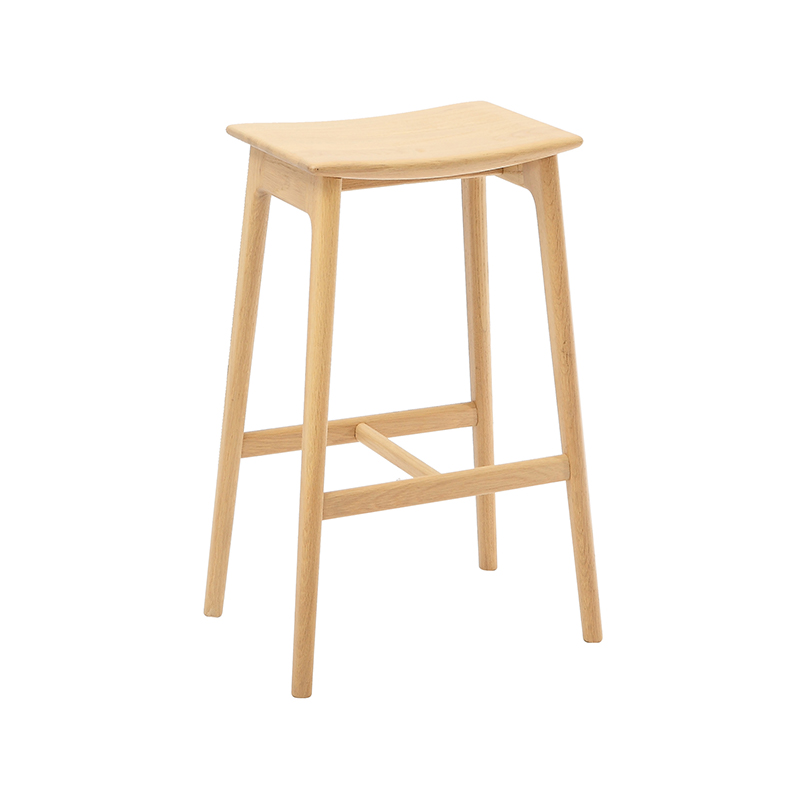
Oak, beech, and ash each bring a distinct visual character alongside their structural credentials. Oak's pronounced grain and warm amber tones are the dominant preference in European residential markets. Beech's close, even grain accepts stain uniformly and is the production standard for high-volume bar stool manufacturing. Ash's open grain and pale color work particularly well in Scandinavian-influenced interiors where the material is left close to its natural state. All three are appropriate choices for kitchen island bar stools in residential settings; the decision is ultimately one of visual character rather than structural adequacy.
The visual tension that makes a well-designed wood bar stool compelling in a modern kitchen is not accidental. It comes from a specific design decision: applying the precision of contemporary furniture design — clean lines, controlled proportions, restrained surface decoration — to a material and a making tradition that are fundamentally about warmth, variation, and the marks of craft.
A wood bar stool with a smooth, uniformly finished frame and a carefully woven rope seat occupies an unusual position in a kitchen. It is modern enough to sit comfortably next to marble countertops and handleless cabinetry, and warm enough to soften the hardness of those materials without clashing with them. This dual quality — contemporary and traditional simultaneously — is difficult to achieve with other materials. Metal stools read as industrial. Plastic stools read as casual at best. Only solid wood carries the inherent warmth that makes it compatible with both minimal and relaxed kitchen aesthetics.
The matte finish characteristic of well-made wood bar stools contributes significantly to this versatility. A high-gloss lacquer finish on a wood stool reads as dated and slightly cheap; a matte or satin oil finish allows the grain and color variation of the timber to remain visually present, and ages gracefully as the piece is used. This finish quality also eliminates the visual competition between the stool surface and the other materials in the kitchen — the stool becomes a complement rather than a focal point, which is usually the right role for seating at an island.
The compact scale of kitchen island bar stools reinforces this quality. A stool that sits low enough to disappear under the counter when not in use, and rises to become a composed seating element when in use, is a piece that understands its role in the space. The best designs in this category are substantial enough to feel intentional, and refined enough to stay out of the way.
Hangzhou Changshun Furniture Co., Ltd. has been manufacturing wooden and rattan chairs and tables from its facility in Fuyang, Zhejiang Province for over two decades. The company's production scope covers the full cycle from timber selection through finished product — design, development, production, and quality control are all managed within the same operation, which gives buyers direct control over specification at every stage.
The wood bar stool range is produced under FSC certification, ensuring that the timber supply chain meets internationally recognized standards for responsible forest management. This certification is increasingly a baseline requirement for buyers in European and North American markets where procurement policies and consumer expectations around sustainability have converged, and Changshun's long-standing FSC status means this documentation is available without additional lead time or cost.
OEM and custom development capacity allows buyers to configure bar stool specifications — wood species, seat height, backrest design, surface material (rope weaving or leather), and finish — to match their specific market requirements and brand aesthetic. Experienced in-house technicians manage the development process from sample to production, with the manufacturing discipline to hold specification consistency across bulk production runs.
The company's export markets include Europe, North America, Southeast Asia, and the Middle East — markets with distinct aesthetic preferences and quality standards that have shaped Changshun's product development over more than twenty years of international supply. That accumulated understanding of what different markets require from a wood bar stool — in terms of proportion, joint specification, surface finish, and packaging — is the practical foundation of a reliable supply partnership.
Explore Changshun's full wood furniture range — including wood upholstered chairs, wood dining chairs, and wood tables alongside the bar stool series — or contact the team directly to discuss custom specifications and bulk pricing.




Innovation Oriented, Quality As Life.
Feel free to reach our if you want to collaborate with us, or simply have a chat.
Become a Client 
Product Category
Wood Upholstered Chair
Woven Wood Chair
Wood Bar Stools
Wood Table
FSC Certified Wood Chairs
Wooden Rattan Chairs
Solid Wood Dining Chair
Modern Wooden Dining Chair
Contact Information
 +86-571-63521858
+86-571-63525898
 furniture@hzchangshun.com
emilypeng@hzchangshun.com
 No. 88, Zhumufan, Yushan Township, Fuyang District, Hangzhou City, Zhejiang Province, China


 EN
EN

 English
 中文简体
中文简体 Español